
A tablet can quiet a room in seconds.
A custom storybook usually does the opposite.
It invites questions, cuddles, pauses laughter, and sometimes even a hard but healing conversation.
That is the real difference in custom storybooks versus screen time.
One often keeps a child occupied. The other can help a child feel seen.
For many families, this is not an either-or decision every day. Screens are part of modern life, and sometimes they are useful. Parents need to make dinner, answer work messages, help another child, or simply catch their breath.
But when families are looking for something that supports connection, confidence, and emotional growth, personalized reading offers a very different experience from passive digital entertainment.
Custom Storybooks Versus Screen Time: What Changes for a Child?
The biggest shift is not only what the child is doing.
It is how they are participating.
Most screen time asks a child to watch, tap, swipe, or react quickly to what is happening in front of them.
A custom storybook asks a child to imagine, reflect, predict, listen, and connect the story to their own life.
That matters because young children learn best through relationships and repetition.
When a child hears their own name in a story, sees details that resemble their family, or recognizes a fear they are working through, the story lands differently.
It feels personal because it is personal.
Instead of consuming content made for a wide audience, the child enters a story that affirms who they are.
This can be especially meaningful during big feelings or big transitions.
Starting school, welcoming a new sibling, managing separation anxiety, building confidence, or making sense of identity are not small experiences in a child’s world.
A personalized book can meet those moments with gentleness.
A screen may distract from the feeling for a while.
A thoughtful story can help a child begin to process it.
Why Passive Entertainment and Active Reading Feel So Different
Not all screen time is the same.
And not all books are equally engaging.
That nuance matters.
A high-quality educational program watched with a caregiver is very different from endless autoplay videos. In the same way, a rushed bedtime story can feel less meaningful than a shared reading ritual where the child feels calm, included, and emotionally safe.
Still, the general pattern is clear.
Screens move fast.
Stories make room.
Fast-moving digital content is often designed to hold attention through constant novelty. Bright visuals, quick cuts, sound effects, and instant feedback can be very stimulating. That is part of why children often find screens so compelling.
But that same pace can make it harder for children to practice patience imagination, and sustained attention away from a device.
A custom storybook works in the opposite direction
It slows the experience down.
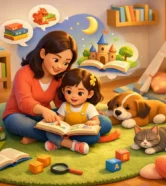
A parent can pause and ask:
“How do you think she feels here?”
A child can point to a picture and say:
“That looks like Grandma’s house.”
The same story can be read again next week, and the same page may start a completely new conversation.
That slower rhythm supports comprehension, emotional language, memory, and a sense of safety.
The Developmental Value of Seeing Themselves in a Story
Children do not just enjoy recognition.
They build from it.
When a child becomes the hero of a story, the message is subtle but powerful:
Your experiences matter.
Your feelings make sense.
You are capable of growth.
This is one reason personalized books can support more than literacy.
They can strengthen identity and belonging.
For multicultral families, multilingual households, adoptive families, blended families, and children who do not often see their world reflected in mainstream books, personalization can fill an important gap.
Representation is not just a bonus feature.
It shapes whether a child feels included in the story world at all.
There is also a practical emotional benefit.
Children often talk more openly about hard things when those feelings are held by a character. If that character is clearly based on them, the conversation can become both safer and more relevant.
A child who resists talking directly about worries may be willing to talk about what “storybook me” was feeling.
That small shift can open the door to connection.
At Maple Kids, this is where personalized storytelling becomes more than a cute keepsake. It becomes a tool for emotional learning, not by lecturing children, but by helping them recognize themselves with kindness.
Custom Storybooks Versus Screen Time at Bedtime
Bedtime is where many parents feel the trade-off most clearly.
Screens can seem convenient when everyone is tired.
But they can also leave children more activated, not less. Even when a show appears calm, the experience can keep a child externally focused and mentally busy.
A personalized book supports a different kind of transtion.
The child hears a familiar voice. Their body settles into a predictable routine. The story creates emotional closeness at the exact moment when many children need reassurance most.
This can be especially helpful for children who struggle with bedtime fears, separation worries, or overstimulation.
A story that reflects their own world can help them feel secure because it gently says:
“Your feelings are understood.”
“You are not facing them alone.”
That kind of co-regulation is hard to recreate with a device.
When Screens Are Useful and When Books Are Better
A balanced conversation needs honesty.
Screens are not automatically harmful, and parents do not need more guilt added to an already full day.
There are moments when screen time is practical, educational, or simply necessary. Video calls with relatives, movement-based learning apps, and age-appropriate content used intentionally can all have a place.
The better question is:
What do you want this moment to do for your chid?
If you need ten minutes to pack lunches, a short program may serve a practical purpose.
If you want to help your child wind down, feel connected, build language, or work through a life change, a custom storybook is usually the stronger choice.
Different tools serve different needs.
This is where many families find relief.
They do not need perfection. They need clarity.
Not every quiet moment has to become a developmental milestone. But it helps to know which activities tend to nourish the deeper skills most parents care about over time:
Empathy.
Resilience.
Attention.
Self-understanding.
Connection.
What Parents and Professionals Often Notice First
The first benefit is not always improved reading skills.
Often, it isemotional engagement.
Children lean in more when the story feels like it belongs to them.
They ask to read it again. They remember details. They bring up the characters later because, in a meaningful sense, the characters are connected to their people, their feelings, and their life.
Educators and therapists often value this same quality.
Personalized stories can give children a gentle, nonthreatening way to revisit difficult themes. A child may not be ready for a direct lesson about courage, grief, friendship struggles, or social anxiety.
But they may be ready for a story where someone like them faces those feelings and finds support.
That does not mean a book replaces professional care or solves every challenge.
It means stories can reinforce the emotional work already happening at home, in classrooms, or in therapy.
They become one more caring layer around the child.
Choosing a Better Screen-Free Alternative
If you are comparing custom storybooks versus screen time, the goal is not to make family life look perfect.
The goal is to choose more intentionally.
Look for stories that reflect your child accurately and respectfully The best personalized books go beyond placing a name into a generic plot.
They consider family context, identity, emotional needs, and the messages a child is absorbing about themselves.
That deeper level of personalization is what turns reading into reassurance.
It tells a child:
“You belong here.”
“Your story is worth telling.”
“You can grow through hard things.”
Those are not small messages.
They can shape how children see themselves long after the book is closed.
There will still be days when the easiest option is a screen.
That is real life.
But if you are trying to create more moments of closeness, calmer routines, and meaningful learning, a custom storybook offers something screens rarely can:
A chance for your child to feel known while they are learning.
And for many families, that is the kind of quiet that matters most.