


A child who whispers, “I can’t do it,” is rarely talking only about the moment in front of them.
It might be the shoes they cannot fasten yet.
The classroom that feels too big.
The new social situation that makes them pull back.
One gentle way to use storybooks for child confidence is to give children a safe place to practice courage before real life asks for it.
Stories matter because chidren do not build confidence from praise alone.
They build it by seeing what courage looks like. They build it by feeling understood. They build it by trying, little by little, and discovering that hard things do not always mean impossible things.
A well-chosen storybook can help a child recognize fear, name effort, and imagine success without pressure. When a child sees a character struggle, adapt, ask for help, and keep going, confidence starts to feel possible.
Not perfect.
Possible.
Why Storybooks Support Confidence So Well
Confidence in young children is often misunderstood.
It is not loudness.
It is not perfection.
It is not being fearless.
Real confidence is the growing belief that:
“I can try, even if this feels hard.”
That is exactly where storybooks can help.
A story gives children emotional distance. When the challenge belongs to a character, children can look at it more calmly. They can notice the worry, the mistake, the disapointment, and the recovery without feeling exposed.
That makes it easier to talk about big feelings.
A child who would never say, “I’m scared to make friends,” may eagerly explain why a character felt nervous on the playground.
Stories also create repetition, and repeition is powerful for emotional growth.
A child who hears the same reassuring pattern again and again starts to internalize it.
The character felt unsure.
The character got help.
The character tried again.
The character discovered they were more capable than they thought.
Over time, those story patterns can become inner patterns.
There is another layer too.
Children are more likely to absorb a message when they feel seen inside it. If the characters, family dynamics, language, culture, or challenges reflect their own world, the story does not feel like a lesson from the outside.
It feels personal.
That sense of recognition can be deeply steadying for a child who is still figuring out who they are.
How to Use Storybooks for Child Confidence at Home
The most effective reading moments usually do not feel like lessons.
They feel close, calm, and consistent.
If your goal is to build confidence, the first step is not reading more books at once. It is reading more intentionally.
Choose stories where confidence is shown through action, not simply announced.
A character who solves every problem easily may be entertaining, but that does not always help a child who feels unsure of themselves.
More helpful stories show hesitation, mistakes support, and small wins.
Children need to see that bravery can look quiet.
They need to see that growth often happens in steps.
As you read, slow down around the emotional turning points.
If a character is nervous, pause there.
If they try again after failing, stay with that moment.
You do not need a long explanation. A simple reflection is often enough:
“That felt hard, and they still kept going.”
This helps children connect confidence with effort rather than performance.
It also helps to keep the conversation open-ended.
Instead of saying, “See? You should be brave like that,” try asking:
“What do you think helped them?”
“Have you ever felt like that?”
“What would you do next?”
This keeps the child safe inside the conversation.
Confidence grows better through connection than correction.
Routine matters more than intensity too.
A short bedtime reading ritual can do more for a child’s self-belief than one big conversation every now and then.
When reading becomes a dependable part of the day, children associate stories with comfort. That emotional safety makes them more open to what the story is gently teaching.
The Best Kinds of Books for Building Confidence
Not every confidence-building book works for every child.
Some children need stories about trying new things. Others need stories about belonging, speaking up, making mistakes, or moving through change.
The right book depends on what confidence looks like for your child right now.
For a child who hesitates to try, look for stories about first attempts.
A first day of school.
A first swim lesson.
A first sleepover.
A first performance.
A first friendship challenge.
These stories can normalize uncertainty and show children that new experiences do not have to feel easy to be worthwhile.
For a child who is hard on themselves stories about mistakes can be especially helpful.
The most supportive books do not pretend mistakes feel fine right away. They show disappointment, frustration, and recovery.
That sequence matters.
It teaches children that failure is not the opposite of confidence.
Often, it is part of building it.
For children navigating identity, representation matters just as much as plot.
A child who sees their name, appearance, family structure, culture, language, or emotional reality reflected in a story may feel a stronger sense of belonging.
That belonging is a foundation for confidence.
It is easier to feel brave when you do not also feel invisible.
This is where personalized storytelling can be especially meaningful.
When a child becomes the hero of the story, the message lands differently.
A personalized book can reflect not just a child’s name, but the real challenge they are facing: shyness, a move, separation anxiety, a new sibling, bedtime worries, or feeling different from peers.
At Maple Kids, that kind of storytelling is designed to help children see themselves with warmth and possibility, not just watch someone else be brave.
What to Say While You Read
Many parents worry they need the perfect words.
You do not.
What matters most is tone.
If your voice says, “You are safe, and I’m with you,” the conversation already has what it needs.
Use language that notices effort.
“They kept practicing.”
“She asked for help.”
“He felt nervous and still took one step.”
“That was hard, but they did not have to do it alone.”
These small observations teach children what confidence is made of.
Try not to rush toward reassurance every time.
If a character is embarrassed or scared, let that feeling breathe for a moment.
Children gain confidence not when adults erase discomfort, but when they learn that discomfort can be handled.
You can say:
“That was a tough moment
Then gently add:
“I wonder what helped next.”
It can also help to connect the story to real life softly.
If your child has an upcoming challenge, you might say:
“This reminds me a little of your soccer class.”
Then stop.
Give them space.
Some children will open up right away. Others may need several readings before they make that connection themselves.
That is okay.
The story is still doing its work.
When Storybooks Are Not Enough on Their Own
Storybooks are powerful, but they are not mmagic by themselves.
If a child is dealing with intense anxiety, ongoing social withdrawal, school refusal, or deep distress, stories work best as one support alongside responsive adults, steady routines, and sometimes professional care.
Even in everyday situations, books cannot do the whole job if a child never gets chances to practice confidence in real life.
Reading about bravery helps.
Living small moments of bravery helps the lesson stick.
That might mean ordering their own snack, greeting a classmate, trying a new activity, asking for help, or speaking up when something feels wrong.
The good news is that stories can prepare children for those moments.
They give language.
They give emotional rehearsal.
They give hope.
Then real life offers the next small step.
A Quieter, Steadier Way to Build Self-Belief
If you want to use storybooks for child confidence, think less about delivering a lesson and more about creating an experience.
Sit close.
Read slowly.
Choose stories that reflect your child’s world.
Let the message arrive more than once.
Chidren do not usually become confident all at once.
More often, confidence grows in small layers.
A story they ask for again.
A character they relate to.
A feeling they finally name.
A risk they decide to take.
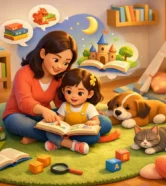
Sometimes the strongest kind of courage begins in a lap, with a page turning, and a child realizing they might be able to do hard things after all.