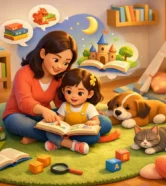



A child who keeps wandering away from story time is not necessarily “not a reader.” They may be telling us that the book feels too distant, too difficult, or simply unrelated to what is filling their mind that day. This guide to child centered reading is about meeting children at that point of interest and building a reading experience around their voice, questions, and everyday life.
For Maple-Kids families, this fits within the School & Learning topic and is especially useful for children ages 3 to 8 who are building confidence with books, language, attention, and early literacy. The goal is not to make every read-aloud a lesson. It is to help a child feel that books are a place where their ideas matter.
What child-centered reading looks like
Child-centered reading begins with a simple shift: instead of asking a child to fit themselves into a book, we let the book make room for the child. That can mean choosing stories connected to dinosaurs, a new baby, soccer practice, trucks, a treasured grandparent, or a question they have asked repeatedly. It can also mean allowing them to linger on one illustration, interrupt with a story of their own, or request the same book for the fifth night in a row.
The adult still provides gentle structure. You choose a comfortable time, make books available, and offer language when a child needs it. But the child has real participation. They can turn pages, point out details, predict what might happen, decide which story comes next, or say, “That part is like me.”
This approach can support reading confidence because it removes some of the pressure to perform. A child does not need to sit perfectly still, answer every question correctly, or finish every page to have a meaningful reading experience. Their curiosity becomes the starting point.
Why personal relevance matters in early reading
Children work hard to make sense of the world. A familiar detail in a story – a family dog, a favorite yellow raincoat, a recognizable neighborhood routine – gives them something secure to hold onto while they explore new words and ideas.
When a story reflects a child’s experiences, it may help them connect language with meaning. If the character is nervous about joining a classroom activity, proud of packing a backpack, or curious about why the moon changes shape, the child can respond from their own experience. The conversation becomes more natural than a series of comprehension questions.
Personal relevance matters for belonging, too. Children deserve stories that can reflect different family structures, cultures, home languages, abilities, traditions, and ways of living. Seeing these details treated as an ordinary, valued part of a story creates a warmer invitation to participate.
That does not mean children should only read books about themselves. Stories also offer a chance to encounter lives, places, and possibilities beyond their own. Child-centered reading balances both needs: a secure sense of recognition and a gentle path toward discovery.
Start with the child in front of you
Before choosing a book or beginning a read-aloud, notice what is active for your child right now. Perhaps they are fascinated by construction vehicles. Perhaps they are adjusting to preschool, practicing independence, or talking constantly about a recent family trip. These interests are not distractions from reading. They are useful entry points.
Try offering a small choice, such as, “Would you like a funny story or an animal story tonight?” For a child who becomes overwhelmed by choices, offer two books rather than a full shelf. A child who is learning to read may want to read familiar repeated lines while you read the rest. A younger child may only want to name pictures. Each version counts as shared reading.
Pay attention to energy, too. After a long day, an active child may prefer a short, playful story and the freedom to act out a scene. At bedtime, they may need a calmer book with predictable language. It depends on the child and the moment. Reading habits grow more easily when story time feels responsive rather than forced.
Use prompts that invite, not test
Questions can make reading richer, but they can also turn a cozy moment into a quiz. Instead of asking only, “What color is that?” or “What happened on this page?” try comments and invitations that leave room for the child’s ideas.
You might say, “You noticed the tiny backpack,” “I wonder how the character is feeling,” or “This part reminds me of when we visited Grandma.” If a child gives an unexpected answer, stay curious. “Tell me more” is often more helpful than correcting them quickly.
When a child loses interest, it is okay to stop, skip ahead, or revisit the book another day. Protecting the positive feeling around reading is often more valuable than completing every page.
A personalized School & Learning story in action
Imagine a personalized book called Maya’s Backpack of Brave Ideas. Maya is preparing for her first weeks of school and worries that she will not know what to do when the classroom feels busy. The story follows Maya as she packs her backpack with familiar supports: a note from her two dads, a drawing of her cat Pepper, and a small card with three choices she can make when she feels unsure – look around, take a breath, or ask a grown-up for help.
The illustrations consistently show Maya as the main character, using her illustrated likeness, curly hair, favorite purple sneakers, and the family details that make the setting feel like hers. Her classroom can reflect the kinds of books, routines, names, and cultural details that are familiar to her family. The story can be created in her preferred language or include language that is meaningful at home.
This is more than inserting Maya’s name into a generic school story. Her specific concern shapes the plot. Her family’s encouragement appears in a way that feels true to her life. The book gently introduces a small, achievable step without suggesting that she must feel brave all the time.
For a child, seeing a consistent version of themselves move through a challenge can create shared language for real life. A parent might later say, “Which brave idea would Maya try?” The question is low-pressure, familiar, and connected to a story the child already knows. It can support practice without shame or a lecture.
Make the story continue after the last page
Child-centered reading works best when the book becomes part of family conversation, not another task to check off. After reading, leave the book where the child can reach it. Let them retell the story to a sibling, bring it to a quiet corner, or point to a page that feels important. Repetition is not a sign that you need a new book immediately. It is often how children revisit language, emotions, and details at their own pace.
One practical takeaway is to keep story time short enough to end well. Five connected minutes can be more meaningful than twenty minutes of coaxing. Another is to notice which parts your child returns to. Their favorite page may reveal an interest, a question, a worry, or a source of comfort that can guide your next conversation.
For educators and caregivers, the same principle applies in a group setting. Offer books with varied characters and experiences, then make room for children to respond in different ways. One child may speak at length, another may point, draw, move, or listen quietly. Participation does not have one correct shape.
Reading that says, “You belong here”
A thoughtfully personalized story can make reading feel less like something delivered to a child and more like something made with them in mind. Maple-Kids can create a School & Learning book around a child’s real interests, family, language, everyday routines, and questions, while keeping the storytelling warm, age-appropriate, and visually engaging.
The most useful reading routine is not the most elaborate one. It is the one where a child feels safe to be curious, heard when they respond, and eager to return to the page because some part of the story feels wonderfully, recognizably theirs.