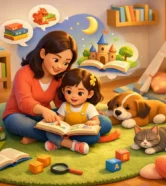



A child who is melting down over the wrong color cup is rarely upset about the cup alone. They may be tired, overwhelmed by a change in routine, worried about preschool, or carrying a feeling they do not yet have words for. Stories for emotional regulation give children a gentle place to recognize those big feelings before they have to manage them in real life.
A well-chosen story does not make sadness, anger, or fear disappear. Instead, it helps a child understand that feelings can be named, expressed safely, and moved through. When the main character feels nervous before a new class or frustrated when a tower falls down, children can watch a calming response unfold from the comfort of a lap, a couch, or a quiet bedtime routine.
Why Stories for Emotional Regulation Work
Young children learn through repetition, relationships, and imagination. A story combines all three. The repeated phrases become familiar language for hard moments. Reading beside a trusted adult provides safety and connection. And imagination creates enough distance for a child to look at a feeling without feeling exposed by it.
A child may resist a direct question such as, “Why are you so upset?” Yet they may eagerly explain why a story character is crying, hiding, shouting, or refusing to join the group. That conversation can become a bridge. “I wonder if you have felt a little like Maya today?” is often easier to hear than a lesson about behavior.
Stories can also offer a simple sequence children can remember: a problem happens, the character notices how they feel, they ask for help or use a calming strategy, and the feeling changes. This matters because emotional regulation is not about being cheerful or quiet all the time. It is about learning that feelings carry information and that children have safe choices when those feelings become too big.
For parents and caregivers, a book can lower the pressure of finding perfect words in the middle of a difficult moment. You are not required to solve every feeling immediately. Sometimes the most helpful thing is to sit close, read slowly, and let a child borrow the language and courage of a character.
What Makes an Emotional Regulation Story Helpful?
Not every book about emotions supports regulation in the same way. Some stories focus mainly on labeling feelings, which is a valuable first step. Others show a character practicing what to do next. The strongest stories usually make room for both.
Look for characters whose emotions have a clear, relatable cause. A child can understand being disappointed when playtime ends, nervous about sleeping somewhere new, jealous when a sibling gets attention, or angry when a game does not go their way. Specific situations help children connect the story to their own experience.
It also helps when the story treats the emotion with respect. Children need to hear that anger is not bad, fear is not silly, and tears are not a failure. The behavior that follows a feeling may need guidance, but the feeling itself deserves care. A story that shames the character for being upset can make a child feel they must hide rather than communicate.
Helpful stories include realistic, age-appropriate coping choices. A character might take a slow breath, squeeze a pillow, stomp safely, use words such as “I need space,” ask a grown-up for help, or try again after a break. These strategies work best when they are presented as options rather than magic fixes. A deep breath may help one child feel steadier; another may need movement, a snack, quiet, or a hug first.
Finally, the ending should offer hope without demanding a perfect turnaround. A child does not need every story character to become instantly calm. It is enough for the character to feel understood, repair a hurt moment, or discover one small next step.
Personalization can make the lesson feel more real
Children often connect most deeply when a story reflects the details of their own world. Seeing their name, appearance, family structure, language, traditions, or a familiar challenge within a story can turn an abstract lesson into something personal: “This feeling happens to me, and I can handle it.”
That is the heart behind personalized developmental storytelling. At MapleKids, a child can become the hero of a story shaped around their experiences and emotional needs, whether they are adjusting to a move, building confidence at school, welcoming a new sibling, or working through a fear. The technology serves the relationship, not the other way around. The goal is a meaningful story that helps a child feel seen by the adults who love them.
Personalization is especially valuable for children who do not often see themselves or their families represented in books. Belonging supports emotional safety. When children recognize their own family and identity in a story, the message of comfort and capability can land with greater warmth.
How to Read Stories for Emotional Regulation Together
The conversation around the book matters as much as the book itself. You do not need to turn every read-aloud into a formal lesson. A few calm, curious comments can help children practice emotional awareness without feeling tested.
Before reading, notice the child’s state. A child who is already highly upset may not be ready to discuss a story right away. In that moment, focus on safety and co-regulation first: stay nearby, use a calm voice, offer water or a quiet space, and keep your language simple. The story may be more helpful later, when their body has settled.
During a peaceful reading time, pause at one or two moments rather than interrupting every page. You might say, “His hands look tight. What do you think he is feeling?” or “What could help her feel safe right now?” If your child does not answer, that is okay. They are still listening, observing, and building a mental map for future moments.
After the story, connect it gently to daily life. “The character used a cozy corner when things felt loud. Would you like to make a cozy spot for your room?” Or, “She told her dad she needed help. What words could we use when you need help?” Keep the practice concrete and small. Children are more likely to use a skill they have rehearsed during calm moments.
Re-reading is not a sign that a child has outgrown a book. It is often how the learning settles in. When children ask for the same story again, they may be returning to a feeling, a reassuring ending, or a strategy they are trying to make their own.
Matching the Story to the Moment
For worries and separation anxiety, choose stories where the character experiences uncertainty but finds a steady connection to home, a caregiver, or a comforting routine. For anger, look for books that separate the feeling from harmful actions and show safe ways to release energy or repair after a mistake.
For transitions, stories can prepare children before the event happens. Reading about the first day of school, a new home, a doctor visit, or a family change gives a child language and predictability before emotions rise. In these cases, read the story more than once before the transition, then return to it afterward to make space for what was different from what they expected.
For grief, trauma, or emotional distress that feels intense, persistent, or disruptive to daily life, stories can be comforting but may not be enough on their own. A pediatrician, child therapist, school counselor, or other qualified professional can help families find support that fits the child. A story remains a caring companion, not a substitute for needed care.
Let the Story Continue Beyond the Page
The most powerful emotional lessons are often carried into ordinary moments. A child remembers that a character took “balloon breaths” and tries one while waiting in the grocery line. They recall that a hero asked for help and use the same words after a playground conflict. They learn that a hard day can include a repair, a cuddle, and another chance tomorrow.
When you share stories that honor a child’s inner world, you are offering more than a calming activity. You are showing them that every feeling has a place in the family story, and that they do not have to face the biggest ones alone.