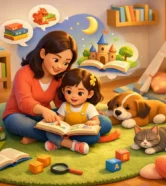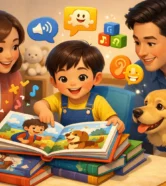

A child who points at the dog on every page, says one new word at bedtime, or retells the same part of a favorite story is doing meaningful work through play and connection. So, can personalized books help speech development? They can support the everyday interactions that give children reasons to listen, notice, respond, and try words of their own.
A book is not speech therapy, and it cannot diagnose or resolve a communication concern. But a thoughtfully made story can become a low-pressure setting for rich back-and-forth talk, especially when its main character looks like the child, knows their family, and faces experiences they recognize. For many young children, it is easier to talk about a story version of themselves before talking directly about their own day.
Topic focus: Knowledge & Discovery – Why/How/What Discovery Best suited for: Ages 2 to 6, with the language and story length adjusted for the child Parent need: More natural, enjoyable opportunities for conversation and vocabulary practice Book concept: How Does Maya’s Voice Travel? follows Maya and her dog Pepper as they investigate how people make sounds, listen to one another, and use words, gestures, and facial expressions to share an idea.
Why familiar stories invite more conversation
Young children do not need a quiz at story time. They need an adult who is interested in what they notice. A personalized story gives that conversation a familiar starting point: “What is Maya holding?” becomes “What are you holding in this picture?” A child may answer with a word, a sound, a point, a gesture, or a longer idea. Each response is a chance to connect.
Personalization can lower the distance between the page and real life. When a child sees their own illustrated likeness putting on rain boots, visiting Grandma, feeding a pet, or playing at a neighborhood park, they already understand much of the context. That familiarity can free up attention for the words and ideas in the scene.
It also gives adults something more meaningful to talk about than a random character’s adventure. “Remember when Pepper barked at the delivery truck?” may lead to “Our dog barks too,” then “He was loud,” or “I felt surprised.” The goal is not to get a perfect answer. It is to keep the shared exchange going in a relaxed way.
Can personalized books help speech development through repetition?
Often, children choose the same book again and again because repetition feels safe and satisfying. That can be useful. With each rereading, the story becomes more predictable, which may make it easier for a child to join in with a sound effect, finish a familiar phrase, point to a named object, or tell part of the story before the adult does.
A repeated line in How Does Maya’s Voice Travel? might be: “Maya has something to say.” At first, a child may simply listen. Later, they might say “say,” add their own idea, or use the line while playing. The repetition is not meant to pressure them to perform. It creates an opening they can enter when ready.
High-quality illustrations matter here because children use pictures to make sense of language. Clear, expressive scenes can show that Maya is curious, Pepper is startled, or Dad is listening closely. When illustrations consistently represent the same child, family members, pet, and everyday places, children can focus on the changing action and language rather than figuring out who everyone is on each page.
What a speech-supportive personalized story can include
The most helpful language opportunities are woven naturally into the plot. A story about voice and communication might introduce simple action words such as whisper, call, listen, ask, tell, and wait. It can include concrete nouns from the child’s life, such as their pet’s name, favorite snack, stroller, soccer ball, or grandparent’s nickname.
It can also gently show that communication takes many forms. Maya might use words to ask for a turn, point toward the lost red mitten, copy Pepper’s “woof,” or show a worried face when a sound is too loud. This is inclusive of children who communicate in different ways and reminds families that connection does not depend on speaking in one particular style.
For a multilingual household, the story can be created in the language used most comfortably at home, or reflect more than one language naturally in dialogue and family routines. Rich conversations in a family’s home language are valuable. A child does not need to abandon the language that carries their relationships, culture, and everyday memories in order to enjoy books or build communication skills.
The right level depends on the child. A two-year-old may enjoy naming pictures and copying sounds: “pop,” “woof,” “up.” A four-year-old may answer a simple choice: “Did Maya whisper or call?” An older preschooler may predict what happens next or explain why Maya’s friend did not hear her at first. The story should meet the child where they are, not turn reading into a test.
A simple way to read for more talk
You do not need special teaching materials or a long session. Ten unhurried minutes, repeated often, can create a comforting routine. Read the story once for enjoyment. On the next reading, pause at one or two moments that genuinely invite a response.
Try following the child’s attention rather than sticking to every word on the page. If they are focused on Pepper hiding behind a chair, talk about that: “Pepper is behind the chair. Where is Pepper?” If they say “dog,” you might warmly expand it: “Yes, Pepper the dog is behind the chair.” This gives them a slightly fuller model without correcting or demanding that they repeat it.
A few conversation habits can keep story time supportive:
- Leave a little quiet space after a question or comment. Some children need extra time to process and respond.
- Use comments as often as questions. “Maya found the blue ball!” can feel easier to respond to than a series of prompts.
- Accept gestures, sounds, and partial words as communication, then add language around what the child meant.
- Revisit a favorite page rather than rushing to finish the book. The best conversation may happen on one illustration.
If your child says something unexpected, follow it. When they point to Maya’s lunch and say “banana,” the story can briefly become a conversation about their own lunch, a yellow food they like, or the funny time a banana got squished in a bag. Those small detours are often where language becomes personal and memorable.
Keep expectations gentle and realistic
Personalized books can support a language-rich routine, but they are one piece of a larger picture. Children develop at different rates, and some may prefer to listen for a long time before they say much aloud. Others may tell the whole story with enthusiasm but be quieter in unfamiliar settings. Temperament, hearing, language exposure, developmental differences, and life changes can all shape communication.
If you are concerned about how your child understands language, uses words or gestures, responds to sounds, or connects with others, it can help to speak with their pediatrician or a qualified speech-language professional. Seeking guidance is not a failure of home reading. It is one way of understanding what support may fit your child best.
At home, keep the focus on shared enjoyment. A child who feels seen in a story may be more willing to point, laugh, ask, imitate, or tell you what they think. Those moments count, even when they are small.
A book that gives your child a reason to speak
In a Maple-Kids version of How Does Maya’s Voice Travel?, Maya could have your child’s name and illustrated features, Pepper could become their own pet or beloved stuffed animal, and the story could take place in their apartment, house, school, or familiar neighborhood. A family member could appear as the patient listener who says, “I want to hear your idea.” The child’s favorite interest, whether it is dinosaurs, trains, dance, or ocean animals, could become part of the discovery.
That level of care makes the book more than a place to practice words. It becomes a story a child can recognize as theirs, return to often, and share with the people who know them best. Read it slowly, notice what captures their attention, and let their voice, in whatever form it comes, help guide the next page.