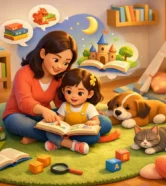



Some of the most meaningful family moments happen in the small space between turning a page and hearing your child say, “Again.”
That is why choosing the top storybooks for family bonding is not really about building a perfect bookshelf.
It is about finding stories that help your child feel close, seen, and safe. It is about giving your family language for love, comfort, reassurance, and connection.
The best bonding books do more than entertain.
They invite cuddles.
They invite laughter.
They invite questions.
They create quiet pauses where a child connects the story back to their own life.
A strong family read-aloud can help after a hard daycare drop-off, during a move, while welcoming a new sibling, or simply at the end of a long day when everyone needs to come back together.
What Makes a Storybook Good for Family Bonding?
Not every popular picture book creates the same kind of closeness.
Some books are funny and energetic, which is wonderful. Others are adventurous, silly, or full of imagination. But books that support family bonding usually offer one or more of these three things:
Emotional warmth.
Shared reflection.
Repeat-read comfort.
Emotional warmth matters because young children often understand love through routine, tone, and familiar words. A story with gentle reassurance or a strong caregiver-child relationship can become part of your family rhythm.
Shared reflection matters because children often open up sideways.
They may not answer, “How did you feel today?”
But they might talk about how a bunny, bear, grandmother, or little girl felt in the story.
Repeat-read comfort is the quiet superpower.
The books children ask for again and again become emotional anchors. Repetition helps them know what comes next, and that predictability can make them feel safe.
12 Top Storybooks for Family Bonding
1. The Kissing Hand by Audrey Penn
The Kissing Hand remains a favorite for a reason.
Its gentle story about separation and reassurance helps children feel connected to home, even when they are away from it.
For families dealing with school transitions, daycare nerves, bedtime clinginess, or separation anxiety, this book offers a simple ritual children can carry with them.
It also gives parents comforting language for hard goodbyes, which can be just as valuable on difficult mornings.
2. Guess How Much I Love You by Sam McBratney
There is a softness to this book that makes it especially lovely for winding down together.
The back-and-forth expressions of love between Little Nutbrown Hare and Big Nutbrown Hare feel playful, but they also give children language for affection.
It works beautifully for toddlers and preschoolers because the message is easy to understand.
This is not a book with a complicated plot. It is a book about closeness. And sometimes that is exactly what bedtime reading needs.
3. Love You Forever by Robert Munsch
Few children’s books bring out stronger feelings than Love You Forever.
Many parents treasure it for its picture of lifelong, unconditional love. Others find it deeply emotional, even a little heavy.
That is worth knowing before choosing it.
If your family appreciates sentimental stories, this book can become a powerful read. If your child prefers lighter bedtime books, it may feel like too much.
Its impact depends on your child, your season of life, and the kind of mood you want story time to hold.
4. Owl Moon by Jane Yolen
Owl Moon is a quieter choice, and that is part of its beauty.
A parent and child step out together into the winter night, sharing an experience that feels calm, intimate, and full of wonder.
For family bonding, books like this matter because they model presence.
Nothing loud or flashy happens, but the closeness is unmistakable.
It is a lovely reminder that connection often grows in stillness.
5. Last Stop on Market Street by Matt de la Peña
Last Stop on Market Street offers warmth, perspective, and intergenerational connection.
A child and his grandmother move through their neighborhood together, noticing people, beauty, need, and purpose.
This book is especially meaningful for families who want stories that reflect community, diversity, gratitude, and values-based conversation.
After reading, children often have thoughtful questions.
That can open the door to conversations about kindness, belonging, helping others, and noticing beauty in ordinary places.
6. The Family Book by Todd Parr
The Family Book is one of the most accessible books for talking about what makes a family a family.
Its bright illustrations and simple language work well for younger children, while its message is direct without feeling too complicated.
For multicultural families, blended families, adoptive families, single-parent households, LGBTQ+ families, or any family that wants inclusive representation, this book can be a reassuring addition to the shelf.
Sometimes bonding grows when children see their home reflected without explanation or apology.
7. Mama, Do You Love Me? by Barbara M. Joosse
Children often ask big questions in small ways.
Mama, Do You Love Me? meets that need beautifully by exploring whether love stays steady after mistakes, fear, frustration, or difficult behavior.
That makes it a strong choice after emotionally intense days.
The story reminds children that limits and love can exist together.
That is one of the most grounding messages a caregiver can offer.
8. I Love You, Stinky Face by Lisa McCourt
This book brings humor into reassurance, and that balance works wonderfully for many families.
Children love the silly “what if” questions, and parents get repeated chances to answer with steady love.
The message is simple but powerful:
I would love you no matter what.
If your child resists books that feel too sentimental, this can be a better fit. It keeps the emotional core but wraps it in play.
9. Alma and How She Got Her Name by Juana Martinez-Neal
Names carry history, culture, memory, and belonging.
Alma and How She Got Her Name follows a young girl learning the family stories behind her long name.
This book often sparks rich conversations at home.
For families who want children to feel rooted in identity, it has special value. It can naturally lead to sharing your own naming stories, family traditions, and the people your child comes from.
It is a beautiful reminder that a child’s name can hold love from many places.
10. A Chair for My Mother by Vera B. Williams
A Chair for My Mother is a warm and deeply human story about family resilience, shared effort, and care after loss.
What makes it strong for bonding is the way it shows family as a place of teamwork and tenderness.
It can be especially meaningful during seasons of change, financial stress, rebuilding, or emotional recovery.
The story honors struggle without losing hope, which is part of why it stays with so many families.
11. Wherever You Are: My Love Will Find You by Nancy Tillman
This book leans poetic, and many families treasure it for its message of constant love across distance.
It can be especially comforting for military families, divorced households, children with traveling parents, or any child who worries when loved ones are apart.
The language is more lyrical than conversational, so some children will connect to it right away while others may need your voice and warmth to carry the meaning.
Read slowly and gently, it can create a strong sense of safety.
12. Personalized Family Storybooks
Some of the top storybooks for family bonding are not classics at all.
They are personalized stories built around your child, your family, and what your child is actually experiencing.
That matters because bonding deepens when a child feels fully recognized.
A personalized story can include their name, family structure, cultural background, worries, strengths, routines, and milestones.
If your child is facing a new sibling, a move, bedtime anxiety, school nerves, or questions about identity, a custom book can turn reading time into emotional support instead of generic entertainment.
Thoughtfully made personalized books, including those created by Maple Kids, can help families move from passive reading to real connection.
They do not just tell a child a story.
They tell the child:
“This story has room for you.”
How to Choose the Right Bonding Book for Your Family
The best choice depends on what your child needs right now.
If your child is dealing with separation anxiety, choose books that reassure.
If your family wants more laughter at bedtime, reach for something playful.
If you are trying to support identity, transitions, or inclusion, look for stories that reflect real family life.
Age matters, but emotional fit matters more.
A four-year-old may love a simple board book because it feels cozy and familiar. Another child the same age may be ready for richer themes and longer conversations.
You do not need the most award-winning book.
You need the one your child wants to hear from your lap.
It also helps to notice what happens after the story ends.
Does your child snuggle closer?
Do they ask questions?
Do they act out the story?
Do they bring it up the next day?
Those are signs the book is doing bonding work.
Making Story Time Feel More Connecting
A bonding book works best when the experience around it feels unhurried.
Even ten minutes can be enough if your child feels your attention is really there.
Put the phone aside.
Let the pace slow down.
Leave room for interruptions.
Children often connect most deeply when they can pause the story to point, wonder, ask questions, or tell you something that seems unrelated at first.
Those little interruptions are not distractions from bonding.
They are often the bonding.
It can also help to read the same book across several nights, especially during emotionally sensitive seasons.
Repetition is not a reading failure.
It is often how children build comfort, memory, and understanding.
And if your child wants to see themselves in the story more directly, trust that instinct.
Children bond not only through closeness with a caregiver, but also through the powerful feeling of being known.
When a story reflects their world, their name, their fears, or the love that surrounds them, reading becomes more than a routine.
It becomes a place where your family can come back to each other.